

Employee Experience Strategy: A Practical Introduction for Business Leaders. Written by the EXS team at Storytellers Australia
Estimated reading time: 7 minutes
An Employee Experience Strategy is a structured plan to improve, or amplify, how your people feel about where they work, what they do, and the conditions around them. It bridges what they need to thrive with the promise of your Employer Value Proposition building autonomy, mastery, and purpose for your team and stronger recruitment and retention for your business.
You’ve probably heard “employee experience” or “workplace experience” somewhere in a meeting or conference before and have been left wondering what it means for your business. Do you really need a strategy for it? Short answer: yes. Long answer: grab a coffee and read on.
first, what is employee experience?
Employee experience is everything a person sees, hears, feels, and does across their time with your organisation. It’s the full journey shaped by hundreds of moments, big and small. The clearest way to see it is with an employee journey map. Much like a customer journey map, it plots each stage of someone’s time with you. Most maps cover these key moments:
- Attraction: how your Employee Value Proposition (EVP) shows up in job ads, on LinkedIn, and in conversations about you.
- Onboarding: how did the first day, first week, first months at the business feel for the employee?
- Everyday work: tools, workspaces, rituals, and how decisions get made.
- Leadership: how managers communicate, support, and recognise their teams.
- Growth: learning, stretch goals, passion projects, and clear paths forward.
- Moving on: how people leave and how they speak about you afterwards.
Your business already has an employee experience. The good news is that mapping the journey shows you where to start, and a solid employee experience strategy helps you shape what it feels like – minus the guesswork.
so, Where does a great employee experience begin?
With the promise you’ve already made.
Long before someone joins your team, they’ve heard what working with you will be like. That promise lives in your job ads, your interviews, your careers page, and the stories you people share with friends. Together, it forms your employer value proposition (EVP): the mix of offerings and values you provide your people, shaping how they experience work culturally, physically, and digitally. Every business has one, even if it’s never been written down.
Your EVP is the promise. Employee experience is how that promise plays out once someone says yes, from the first-day welcome to the Monday stand-up, to the tools that work when you need them. That’s what makes your EVP the perfect starting point. It shows you what your people were told to expect, so you can see how closely their everyday experience lives up to it.

and how does experience relate to engagement?
Employee engagement measures how involved and enthusiastic people feel about their work. Employee experience is what influences that feeling. Think of engagement as the signal and experience as the source. Improve the experience, and engagement tends to follow.
According to Gallup’s State of the Global Workplace data, 21% of employees in Australia are engaged at work. That leaves a wealth of untapped energy, creativity, and commitment in most workplaces, ready for the businesses willing to invest in it.
What does an employee experience strategy include?
A strong employee experience strategy brings together listening, planning, and storytelling. In most cases, the strategy covers:
- Listening: one-on-one conversations and insights that show how people feel today
- A clear baseline: an honest picture of where your experience shines and where it can improve
- An employee value proposition (EVP): a clear articulation of what makes your workplace the one to join and stay
- Leadership support: practical tools that help managers lead with clarity and care
- Internal communication: consistent stories that connect people to purpose and to each other
- Progress tracking: engagement scores and retention rates to show change over time
Follow-through is where trust is built. Hearing what people share matters most when it leads to visible action.
okay, but What is an employee experience framework?
That’s where a framework comes in. If the strategy is the what, the framework is the how: the structure that keeps every listening asession, story, and leadership tool focused on what helps people thrive. A simple, research-backed one starts with three drivers of motivation at work, pupularised by author Daniel Pink in his book Drive.
- Autonomy: the trust to own how work gets done
- Mastery: room to learn, improve, and grow
- Purpose: a clear link between each person’s work and something bigger
From there, you design everyday moments around those needs, guided by your own values and EVP. That’s how to promise, the experience, and the engagement all come together.
great, Why does it matter?
A full-time week in Australia is 38 hours, and the average full-timer adds another 3.8 hours of unpaid work. That’s more than a third of a person’s waking week, and that’s not including the time we spend thinking about work (yes, shower thoughts included). With that much of a person’s life spent with you, the positive experience you offer is what makes your business the one great people choose.
In short, it’s a win for your people and your business. While your team gains autonomy, mastery, purpose, and a sense of belonging, your business enjoys stronger recruitment and retention.
How can us business leaders improve the employee experience?
Across our team, we’ve sat on both sides of the hiring table, from recruitment and workforce management through COVID-19 to telling the stories of the businesses we partner with. One lesson keeps coming up: the small, everyday moments shape how people feel about work far more than the big announcements.
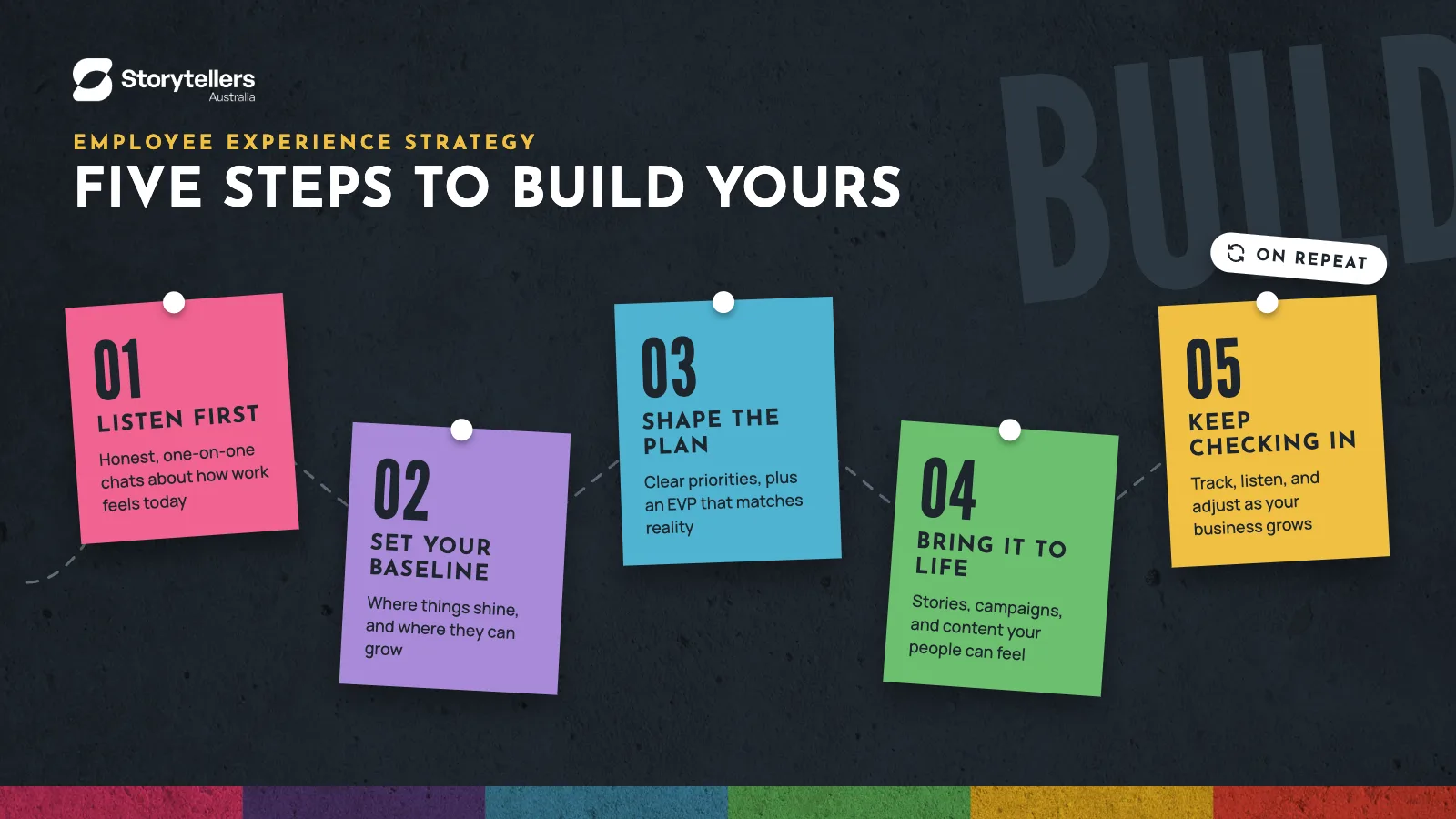
That’s why small but consistent actions make a difference long before a full strategy is in place. Here are five practical places to start:
- Listen first. Start with honest, one-on-one conversations to understand how people experience your business today.
- Set your baseline. Capture where your experience shines and where it can grow, so you can see progress over time.
- Shape the plan. Turn those insights into clear priorities and define or refresh your EVP so it reflects reality.
- Bring it to life. This is where storytelling comes in. Internal campaigns, leadership communication, and employer brand content help people see and feel the change.
- Keep checking in. Track engagement and retention, keep listening, and adjust as your business evolves.
Still curious? Here are some quick answers
Is employee experience the same as employee engagement?
They’re more like close cousins. Employee experience is the whole journey someone has with your business, and engagement is how connected and committed they feel along the way. Look after the first, and second tends to follow.
What is an EVP?
Your Employer Value Proposition (EVP), sometimes called an employee value proposition, is the promise you make to your people: why they choose to join you and what keeps them around. Never written yours down? No stress. A good employee experience strategy helps you define it, using what your people share.
Who should own it?
Everyone has a part to play. Leaders set the direction, people and culture teams bring the expertise, and managers bring it to life every day. Partners like Storytellers Australia can help shape the strategy and tell the story.
How soon will we see a difference?
Some changes, like clearer communication, can be felt quickly. Bigger shifts in engagement and retention build over months, which is why an employee experience strategy works best as a long-term journey with regular check-ins.
How can Storytellers Australia help?
We call our approach EXS (employee experience strategy, with fewer syllables). Every client follows the same three-phase journey, whatever their starting point:
- Phase 1: Listen and set the baseline
- Phase 2: Shape the strategy
- Phase 3: Bring it to life
Our approach is tailored to you and your people, so no two programs will look exactly the same.
Ready to shape your employee experience?
Your people already have a story. Let’s make it one they’re proud to tell.
Our EXS team can help you explore and define what an employee experience strategy could look like for your business.
Book a discovery call
Reusable call booking for other sections of the site.
Choose a day to see its start times.
Loading available days…
Loading available times…
- Available
- Busy
- Your choice
No times are available this week — try another week, or check back soon.
Your details
Closed
